
To watch this video on YouTube, click HERE.
Video Transcript:
It’s time to look at some of the weirdest, most unique, most shocking events from the history of The Church of Jesus Christ of Latter-day Saints that we have never talked about on this channel before.
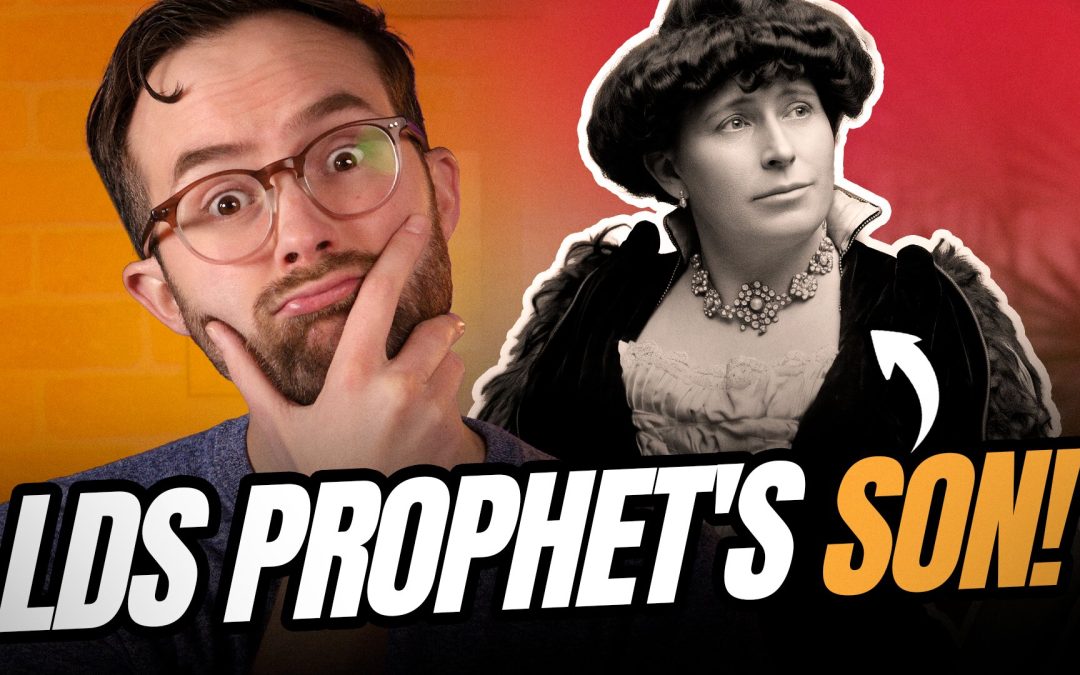
Number 10: This is Brigham Young’s son. Yes, you heard that right — his son: Brigham Morris Young. Around the turn of the century, he was known for his musical performances, dressed in women’s clothing. He performed under pseudonyms such as Miss Bridget McCarthy and the more popular Madame Pattirini. He even sang at one of the birthday celebrations of his father-in-law, Lorenzo Snow.
The cultural baggage associated with drag in the late 1800s was very different than it is today. Brigham had a wife and ten kids. He was a temple worker for about 40 years. It might seem odd to us today, but he was just an entertainer, and it sounds like he was good at it. Fun fact: He also apparently did a comedic bit involving two Chinese men talking with each other, which I’m sure has not aged well at all. President Young died long before his son started performing, but honestly, President Young was a big fan of the theater, and I don’t think he would have had a problem with it.
Number 9: Before the Utah State Capitol building was here, this hill was called Arsenal Hill. There used to be four buildings here where the city’s explosives were kept. On April 5th, 1876, just days before General Conference, some boys were shooting rifles on the hill and accidentally ignited the arsenal. The buildings exploded, sending over 500 tons of rock and other material showering over Salt Lake City. The boys were of course completely obliterated. A quarter mile away, some boys were playing baseball. Some of them were immediately knocked unconscious by the shock wave of the blast. In the city, some people thought it was an earthquake; others, a volcano; and some others thought it was the end of the world. Windows across the city shattered. Boulders were crashing through homes. A few people died from the falling debris. People felt the shock wave for 20 miles. The Tabernacle, where General Conference would be held, lost about 1,000 panes of glass. Just a Twilight Zone level tragedy.
Number 8: When Latter-day Saint settlers arrived in northern Utah, Native Americans warned them of an enormous amphibious man-eating creature that lurked in the depths of Bear Lake. They called it the “Devil fish”. We call it the Bear Lake Monster. Newspapers from the 1800s and early 1900s report several sightings of the monster, with descriptions varying. One skeptic turned believer described it as serpent-like, but covered in fur, and having flippers. Someone else said it was over 50 feet long, 15 feet high, covered in armor-like scales, and had countless arms and legs. Others said it had the legs of a kangaroo and the face of a fish, but with arms on its head instead of ears. In any case, in the early years of settlement, a guy named Phineas Cook set out to catch the beast with a leg of lamb attached to a large hook, strung by a rope up to a buoy with an American Flag on it, which was then strung to a tree on land. This book claims that Brigham Young gave Phineas the rope used in this endeavor, but I haven’t been able to verify that anywhere else yet. Needless to say, Cook failed to capture the beast, though the bait on the hook was apparently taken every time.
Number 7: This is the legendary Dream Mine nestled in the mountain above Salem, Utah. In 1894, a Latter-day Saint named John Koyle had a dream about an angel who told him that this mountain used to contain an ancient Nephite gold mine and treasure cache. He was told to mine into the mountain and find these riches, which he was told would help aid members of the Church in a time of financial crisis. He started a mining company, and church leaders started to worry, questioning the reliability of Koyle’s dream. Some people were taking out bank loans in order to buy stock in the company. The First Presidency denounced the mine in a Deseret News article. Geologist and apostle James E. Talmage inspected the mine and the rock in 1913 and determined that it was pretty much a pointless venture. Long story short, Koyle ended up being excommunicated, the mine has been pretty much abandoned for a very long time, and nothing of real value has ever been excavated. Weird situation.
Number 6: This is the beautiful Manila Philippines temple. Right across the street is the military stronghold, Camp Aguinaldo. During a 1989 military coup, rebel forces laid siege to the loyal government forces in Camp Aguinaldo, and the temple was caught in the crossfire. President Dallin H. Oaks, who was the apostle over the Philippines at the time, reported that eventually “our temple annex and grounds were the last remaining rebel stronghold in Manila and the army had massed artillery and troops for an assault at any moment.” The rebels at the temple had been attacked by a helicopter gunship, the air force dropped bombs nearby that broke windows in the temple annex. The impending assault on the temple would include armored personnel carriers, heavy mortars, and at least 150 soldiers. Long story short, incredibly, the final assault was postponed, and the rebels retreated in the night. Temple grounds were damaged, but the only damage done to the temple itself was a stray rifle shot through a spire.
Number 5: After the murder of Joseph Smith, the Nauvoo Charter was repealed, leaving the city vulnerable without a legal police force or militia during a time of intense persecution. Part of the solution to this problem was the Whistling and Whittling Brigade. If someone came into town looking to cause trouble and did not leave when asked, 20 to 30 men would start to openly follow them while whistling and whittling with their Bowie knives until they left town. One critic of the Church complained to Brigham Young about the intimidation. Brigham Young helped him out but also said, surely with some sarcasm, that he “regretted that we had no police to regulate such things.” As younger and younger boys joined the brigade Brigham Young started to worry the boys might get hurt or might drive the wrong people out of town, so after only a couple of months, the days of the Whistling and Whittling Brigade came to a close.
Number 4: This next one, frankly, deserves an entire episode. But to make a long and terrifying story short — According to records kept by those involved that are stored in the Church History Library, in 1926, a Latter-day Saint woman by the name of Bessie Davis was possessed by a series of evil spirits in Crystal, Idaho. Was it really a mental illness? Or a brain injury? Or a personality disorder? I don’t know, I’m just telling you what the records say. She spoke in different voices and in different accents. She knew things that she shouldn’t have known. She apparently levitated two feet in the air at one point. She was having out-of-body experiences, talking with the spirits of deceased family members. Just… crap was going down.
Now, some of the evil spirits that were attacking her were apparently not unembodied spirits, but disembodied spirits. Meaning, they were the spirits of mortal people who had died. The people that were administering to Bessie had conversations with these spirits. Some of them turned out to be pretty chill, and asked for their temple work to be done, after which they didn’t bother Bessie anymore. Weird weird story. And I’m leaving out a lot. But make of it what you will.
Number 3: The English written language can be frustrating. Tear [teer] and tear [tare] have the same exact spelling, but different pronunciations and meanings. The “s” in “debris” is silent, but not the “s” in “hubris”. Anyway, in the 1850s Brigham Young had had enough and pushed for the adoption of a simpler way to write English, using a new set of phonetic symbols called the Deseret Alphabet. Honestly, it wasn’t a terrible idea, considering the number of immigrants that were flooding to Utah and needing to learn English. Long story short, the Deseret Alphabet never really caught on for a variety of reasons, but it did show up for a short time on coins, gravestones, in books, newspapers, and personal letters. I myself am a proud owner of a Deseret Alphabet Book of Mormon reader. It’s an odd bit of history that even most Latter-day Saints probably aren’t aware of, but now you know.
Number 2: On April 7th, 1893, a very pregnant Emma Bennett was attending one of the dedicatory services of the newly completed Salt Lake Temple. While in the Assembly Hall, wouldn’t you know it, she went into labor. There was no time to take her out of the temple, so she was taken to a smaller room within the temple, where she gave birth to her new baby boy. Apostle James E. Talmage wrote in his journal: “Some sects would hold that such an event desecrated the holy place; but the Latter-day Saints will take a directly opposite view.” The boy was named Joseph Temple Bennett.
Number 1: OK, this one is more of a cultural trend but it was way too weird not to mention. Back in the 1800s, Latter-day Saints viewed consecrated oil as holy, but many also viewed it as actual medicine. If you broke your arm, they might anoint your arm with oil. Many people drank consecrated oil hoping to improve their health. And I know this seems weird to us today, but if someone was experiencing bowel issues, like constipation or hemorrhoids, in the 1800s, it was fairly common to perform enemas that sometimes included consecrated oil. You can even read about this practice in Brigham Young’s office journal here. If it gets the job done, it gets the job done, you know what I mean?
And interestingly, men ordained to an office in the priesthood were not the only members who anointed the sick using consecrated oil. The reality is that for many decades, both Latter-day Saint men and women used to anoint and bless the sick. We talk all about it in this episode. Go check it out! I’ll see you there.
Resources:
— “‘I Intend to Get Up a Whistling School’: The Nauvoo Whistling and Whittling Movement, American Vigilante Tradition, and Mormon Theocratic Thought,” by Jeffrey David Mahas in Journal of Mormon History, vol. 43, no. 4, 2017, pp. 37–67: https://tinyurl.com/3eufhmre
— “Nauvoo’s Whitling and Whittling Brigade,” by Thurmon Dean Moody, in BYU Studies Quarterly, Vol. 15, issue 4 (1975): https://tinyurl.com/45bbbrun
— https://tinyurl.com/3eufhmre
— See chapter “The Bear Lake Monster,” in “Lost Landscapes: Utah’s Ghosts, Mysterious Creatures, and Aliens,” by Linda Dunning: https://tinyurl.com/hv5vc36m
— See also, “Why Brigham Young Lent a 300-Foot Rope to Help Trap the Bear Lake Monster,”
by Katie Lambert in LDS Living: https://tinyurl.com/ypvsk3ts
— Regarding the use of consecrated oil for… health: Here’s that Brigham Young Office Journal entry (March 2, 1860, pp. 47-48): https://tinyurl.com/mtdt6bka. See also “Brigham Young: Pioneer Prophet,” by John G. Turner, pp. 311 & associated fn. See also “‘Pouring in Oil’: The Development of the Modern Mormon Healing Ritual,” by Jonathan A. Stapley: https://tinyurl.com/2546ntkp.
— For more on the 1989 Philippines military coup & the Manila Temple, read this: https://tinyurl.com/3mhv5kyc
— For more on the temple birth of Joseph Temple Bennett: https://tinyurl.com/3zmkn5fs
— Some contemporary news articles about the Arsenal Hill explosion: https://tinyurl.com/ytp4e84w / https://tinyurl.com/7wtpzubx / https://tinyurl.com/3f7cp7mv / https://tinyurl.com/294d43xs / https://tinyurl.com/4vrk26xw
— For more info about the Bessie Davis possession, you’ll have to request this record from the Church History Library: https://tinyurl.com/2py3kuxt
— For more on the “Dream Mine”: https://tinyurl.com/2zab4fhd
— For more on the Deseret Alphabet: https://tinyurl.com/3998hhrk