
To watch this episode on YouTube, click HERE.
Video transcript:
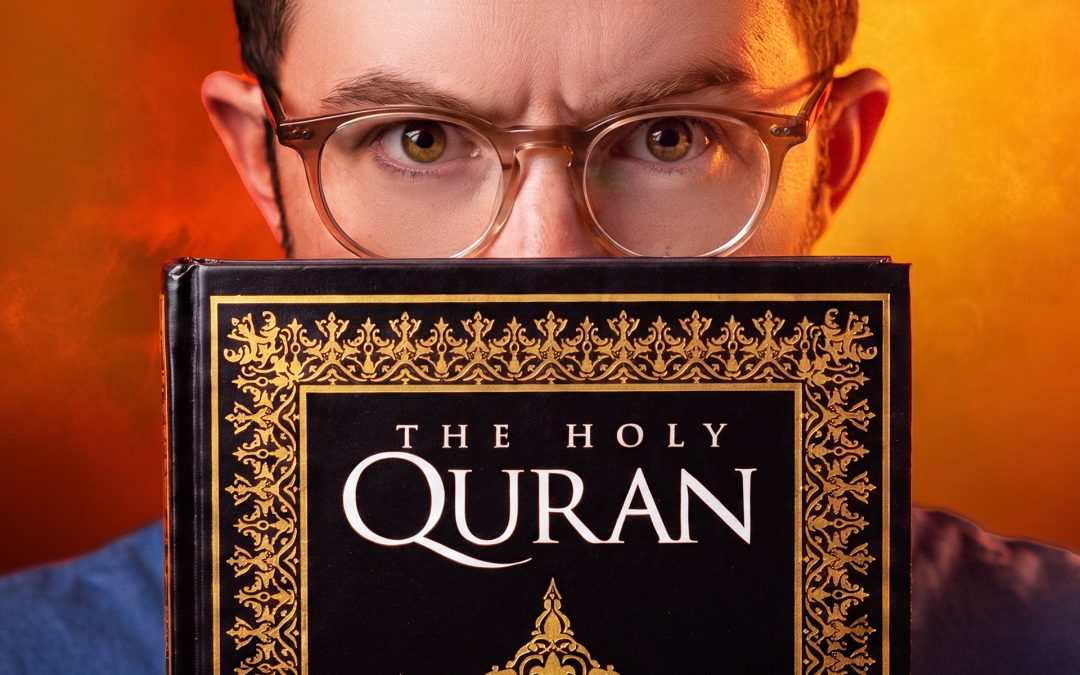
I’m a believing member of The Church of Jesus Christ of Latter-day Saints, and I just read the entire Qur’an. It was not what I expected it to be. I liked a lot of it, but I also came away with some serious questions.
There are about two billion Muslims around the world. Their sacred scripture, the Quran, contains 114 chapters or “Surahs”. These chapters are considered to be revelations from God given to the prophet Muhammad through the angel Gabriel over a span of 23 years back in the 600s AD. They were originally Arabic oral recitations that were later written down and compiled together.
I started reading and quickly realized that the Qur’an is passionately monotheistic. So like, Protestants and Catholics today believe in the Trinity—that there is one God in three persons. The Qur’an is like… no. You can’t… You can’t do that. In Surah 5, it says, “Those who say, ‘God is one in a Trinity,’ have certainly fallen into disbelief. There is only One God. If they do not stop saying this, those who disbelieve among them will be afflicted with a painful punishment.” And of course, Latter-day Saints have a somewhat different understanding of God than both our Muslim and traditional Christian friends.
Now, Muslims are in fact Jesus fans. The Quran teaches that he was a prophet, but that he was not God. Treating anyone as if they are equal with God is a big no-no in Islam. And the Qur’an actually tells some absolutely fascinating stories about Jesus that do not appear in the Bible.
For example, chapter 4 teaches that the Jews “neither killed nor crucified [Jesus]—it was only made to appear so.” And then there’s a fascinating footnote that reads, “The popular belief among Muslims is that a conspiracy was made to kill Jesus, God made the main culprit who betrayed Jesus look exactly like Jesus, then he was crucified in Jesus’ place. Jesus was raised safe and sound to the heavens.”
A poetic ending for Jesus’ betrayer, but where does that leave us when it comes to Jesus’ resurrection? Well, the Qur’an repeatedly affirms that all of humanity will be resurrected, but I learned that Muslims do not believe the New Testament accounts of Jesus’s resurrection, because they don’t believe he ever died in the first place. And put a pin in this because we’re going to circle back.
So at this point, I was realizing that many Islamic beliefs agree with the New Testament, and many others starkly contradict it. And that got me thinking, how do Muslims determine which parts of the New Testament to accept, and which to reject? Well, for Protestants, the highest scriptural authority is the Bible — that is the measuring stick for all other claims. I learned that for Muslims, it’s a similar situation, but their highest scriptural authority — their measuring stick — is the Quran. They believe that Jesus was a prophet primarily because the Quran says so, not because the New Testament says so.
Another source of authority for Muslims is the hadith literature. These are reports about something the Prophet Muhammad said or did that are not formally part of the Quran. According to the hadith, Jesus will come again (similar to our belief in the Second Coming). But when he comes again, he will break the cross, symbolizing his rejection of the Biblical crucifixion and resurrection stories. He will live out a mortal life on earth, and only then will he die and be resurrected.
One of the other stories about Jesus that caught my attention was about his birth. The Qur’an says that right after Jesus was born, people were upset with Mary, thinking Jesus was an illegitimate child. And then, miraculously, baby Jesus starts talking and defends Mary by declaring himself to be a prophet sent from God. Needless to say, very unique!
But while the Qur’an contains some stories and parables, overall, it is not a narrative like the Book of Mormon. It is largely instruction for believers. It would be roughly comparable to our Doctrine and Covenants, in terms of genre. Some of the instruction in the Qur’an I am a big fan of. For example, in our faith, we talk a lot about being peacemakers. So I was happily surprised when I read that,
“The true servants of the Most Compassionate are those who walk on the earth humbly, and when the foolish address them improperly, they only respond with peace.”
Perhaps my favorite passage comes from chapter 90, which explains the path of goodness. “It is to free a slave; or to give food in times of famine to an orphaned relative or to a poor person in distress; and—above all—to be one of those who have faith and urge each other to perseverance and urge each other to compassion. These are the people of the right.”
In fact, every single chapter begins by calling God the “Most Compassionate, Most Merciful,” which I think is really cool. But it’s also partially why I really struggled with this next part.
Throughout the Qur’an, it talks about the blessings and rewards that believers will receive, but also the graphic punishments that “disbelievers” will receive. It says to “fear the Fire fuelled with people and stones, which is prepared for the disbelievers.”
“Surely those who reject Our signs, We will cast them into the Fire. Whenever their skin is burnt completely, We will replace it so they will constantly taste the punishment.”
“…as for the disbelievers, garments of Fire will be cut out for them and boiling water will be poured over their heads, melting whatever is in their bellies, along with their skins. And awaiting them are maces of iron. Whenever they try to escape from Hell—out of anguish—they will be forced back into it, and will be told, ‘Taste the torment of burning!’”
These are disturbing descriptions, and they’re clearly meant to be. But I couldn’t help but wonder, as a Latter-day Saint, would Muslims include me in this category of “disbelievers”? Now, it drives me crazy when non-Latter-day Saints jump to conclusions about our beliefs, without actually talking with believing members. So instead of making assumptions, I wanted to actually talk with some believing Muslims about this. The problem was, I didn’t have any Muslim friends. So, I sent out 10 messages to 10 different Muslim creators, and hoped for the best. Lo and behold, I made a couple of new friends!
This is Dalia Mogahed (MogAhed). She runs a podcast called Quran Conversations. She’s a renowned researcher, author, social scientist — she was an advisor to President Obama — and she was kind enough to field this question for me.
So, God will decide. And that’s fair enough. But regardless of God’s decision, Muslims are expected to treat others with respect. Another new friend, Belal Assaad, emphasized that there are lots of different types of “disbelievers” described in the Qur’an, and that God will judge them differently based on their circumstances. But even if God deals harshly with some people, that does not give Muslims the right to do so.
“…you and I, if you’re a non-believer and I’m a believer in Islam, I can’t call you my brother in faith nor can you call me your brother in faith because we have different faiths … But this does not mean that I look down on you. It doesn’t mean that I now disrespect you or that I mistreat you or oppress you, or backbite you or treat you harshly just because you have a different faith. No that has nothing to do with. That’s between you and God. And I am between me and God. But between me and you? No. We treat each other with respect, with goodness, with, you know, civility … So, when it comes to interaction with each other on this earth, that’s totally separate to how God addresses the disbelievers harshly in the Quran.”
I still have some issues with how the Qur’an describes Hell, but as a Latter-day Saint, I’ve also got issues with the traditional Christian view of Hell as well, so that’s par for the course. But while Dalia and I disagree on some things, it’s not hard to see that she is an excellent human being who cares deeply about treating others with kindness and dignity. And it seems to me that her goodness is intricately and irrevocably intertwined with her Islamic faith. And even if some of the tenets of Islam turn out to be false, I believe that God celebrates that goodness, and so should we.
Now, if researching Latter-day Saint history and scripture over the years has taught me anything, it’s that reading the Qur’an once does not make me an expert on Islam. I’m barely scratching the surface. If I keep digging, I expect I’ll find more of the good, the bad, and the ugly. I’d expect the same of any religion involving human beings.
But this experience did force me to confront something. I don’t want people’s opinions of Latter-day Saints to be shaped primarily by the often-inaccurate representations people see in headlines and popular media. But if I’m being honest, some of my past assumptions about Islam were shaped in exactly that way.
Reading the Qur’an hasn’t convinced me to convert — that was never my reason for reading it to begin with — but it did help me to understand more than 2 billion of God’s children better than I used to. Actually talking with my new Muslim friends forced me to recognize their humanity and goodness in a way that just can’t happen any other way. I have argued and gone full keyboard warrior with people of different faiths in the past. I like the path of understanding a lot more. So go make some Muslim friends. Be confident enough in your own faith to be sincerely curious about theirs. Read their book. Ask questions. A little bit of effort goes a long way.
Now, some people like to claim that the Prophet Muhammad was a fraud, and that the Latter-day Saint prophet Joseph Smith was a fraud just like him. If that’s a claim you’re interested in unpacking, that’s exactly what I did with Dr. Dan Peterson, who is both a Latter-day Saint and a professor emeritus of Islamic studies. Go check it out, and I’ll see you there!