
To watch this video on YouTube, click HERE.
In this video we’re going to look at 10 jaw-dropping examples of LDS Church practices that have changed over time that we haven’t talked about before anywhere else. Buckle up.
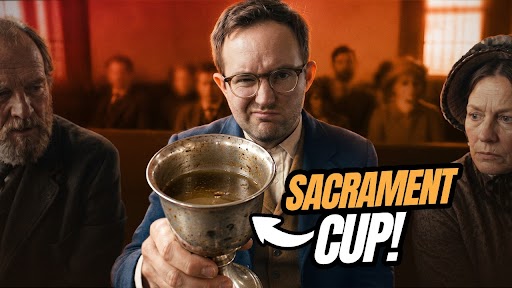
- [The Common Cup] Most Latter-day Saints today are not particularly eager to sit in the front row during sacrament meeting, but back in the 1800s, that was the place to be — for honestly a pretty gross reason. You see, until the early 1900s, members would drink the sacrament water or wine from a common cup. People didn’t like sitting in the back because once that cup reached the back of the chapel, it often had a lot of extra… seasoning. It would often smell like tobacco and be the temporary bathing place for many a mustache, etc.
We largely have the 1918 Spanish Flu pandemic to thank for the switch to individual sacrament cups. That, coupled with an increased understanding of germs and hygiene, helped leaders realize that a common cup probably wasn’t the best idea.
- [Confession] Doctrine and Covenants 59 says that on the Lord’s day, “thou shalt offer thine oblations and thy sacraments unto the Most High, confessing thy sins unto thy brethren, and before the Lord.” And for a time, publicly confessing general sins in a church setting was exactly what some members did. Usually, a public confession was considered part of the repentance process, and was more likely to happen if the sin in question was already widely known.
For one more extreme example, meet John Q. Cannon. In 1884, a Salt Lake Tribune article claimed John had taken his wife’s sister, Louie, as a plural wife. That wasn’t true, and Cannon actually put a beat-down on the reporter for publishing it. But it was true that he was or would soon be having an affair with Louie. He publicly confessed in 1886 at a meeting in the Tabernacle and was promptly excommunicated by his uncle, who was the Stake President. It was quite the scandal. I’m glad people don’t confess like that anymore because… awkward.
- [Temple Recommends] In the early decades of the Church, there was no formal temple recommend interview process at all. There were general guidelines for worthiness as exemplified here, here, and here. But the first actual Church-wide standards weren’t officially published and codified until about 1922. There were seven questions, and that number has fluctuated ever since.
Some questions reflected the concerns of the times. I’ll give just one example. One of the somewhat wordier questions today is, “Do you sustain the President of The Church of Jesus Christ of Latter-day Saints as the prophet, seer, and revelator and as the only person on the earth authorized to exercise all priesthood keys?” It’s a mouthful. But when this question was added in 1976, it was in part meant to weed out members with fundamentalist leanings who might agree that the president of the Church was a prophet, while also believing that others had been given keys to continue authorizing plural marriages.
That’s a very broad overview. There’s so much more to dig into here. We might just do a whole episode in the future on temple recommend changes.
- [Glossolalia] Pentecostals today are known for speaking in unknown tongues, also known as glossolalia. Believe it or not, Latter-day Saints were doing it first. Most Protestant denominations in Joseph Smith’s day were cessationists — meaning they believed that New Testament spiritual gifts like the gift of tongues and healing ended with the apostolic age. Joseph Smith claimed to be restoring that apostolic church, and some members saw these spiritual gifts as evidence that that was indeed happening.
However, the rise of Pentecostalism in the early 1900s, among other factors, prompted Church leaders to re-evaluate their understanding of the gift of tongues. The emphasis on glossolalia shifted to an emphasis on xenoglossia, or the miraculous ability to speak or understand known languages. This is the form of the gift of tongues we associate with foreign-language-speaking missionaries today.
Now, most Latter-day Saints look on glossolalia with a bit of a skeptical eye today. Was this historic practice authentic or just heightened emotion? That’s a question for another episode, but my personal opinion is that God speaks to people not only according to their language, but also according to their culture and understanding.
- [Religion Class] In 1890, a law was passed that banned religious education in Utah public schools. As a result, the Church started the “Religion Class” program, in which LDS students from 1st grade through 9th grade would meet one afternoon every week for religious instruction. It was basically a seminary for younger kids.
Religion Class ended in 1929. We were just getting into the Great Depression, and merging Religion Class with the Primary organization saved money. There were also some church vs. state issues, and interest in the program was just waning. Fun while it lasted, though!
- [Priesthood Ordination] Today, all male members of the Church are expected to be ordained to the priesthood. But for much of the 1800s, that was not the case. Being ordained to a priesthood office was done largely on an “as needed” basis. It was not an expectation for everyone, but that started to change around 1877.
Today, anyone ordained to the priesthood must progress through priesthood offices sequentially, from deacon to teacher to priest to elder, etc. But back in the day, that step-by-step progression did not exist. You could be ordained to any office of the priesthood. For example, the apostle and scholar James E. Talmage was ordained to the office of deacon, teacher, and elder, but he was never a priest.
- [Meeting schedules] Church meeting schedules used to look very different than they do today. Before 1890, children would have Sunday School on Sunday morning, and then, as a community, they’d have sacrament meeting in the afternoon. Fast and testimony meetings were actually on the first Thursday of every month. And then Primary, Young Men’s, and Young Women’s would meet in the evening, once a week, on weekdays.
After 1920, the priesthood and general Sunday School classes would meet on Sunday mornings, and ward sacrament meetings would be in the afternoon. Fasting had shifted to Sunday instead of Thursday. And then Relief Society, Religion Class, Primary, Young Men’s & Young Women’s, in addition to a Genealogy meeting, would take place on weekdays. Schedules have, of course, changed since then and will continue to change in the future.
- [The Handbook (or lack thereof)] There are a lot of moving parts in the Church, and to help things run smoothly, the Church has produced the General Handbook. It’s extremely comprehensive, and online today, it’s even got a helpful little AI assistant. But for the first several decades of the Church, there was no official handbook. The Church was running on pure faith and the charisma of fantastic beards. OK, there was some instruction in scripture, but the practices and traditions of the Church were largely transmitted by word of mouth. The words of our temple endowment weren’t standardized until about 1877, and the first official church handbook — this 14-page pocket-sized booklet — wasn’t published until 1899.
As the Church grew and institutionalized, leaders had to decide what practices and traditions to keep, and what to leave on the cutting-room floor. I know handbooks aren’t the most exciting thing in the world, but really, they have played a huge role in determining what the Church looks like today for you and me.
- [Extemporaneous sacrament prayers]
In the early years of the Church, Protestants and Catholics didn’t really get along. Most early LDS converts were Protestants. They brought with them an aversion to set ritual forms and prayers, which were perceived as too Catholic. Thus, the sacrament prayers as written in the Doctrine and Covenants were used more as a model than as a set script. For example, here’s the scriptural prayer over the sacrament bread, versus a sacrament prayer Brigham Young gave in 1845.
Brigham Young eventually reigned this practice in, and shifted members towards either reading or reciting the prayers from memory. We don’t have any records of extemporaneous prayers after the early 1890s.
- [Tithing In-Kind] Latter-day Saints today generally pay tithing online through the Church’s website, or they can physically hand those offerings to their local bishop. But as per the Church’s website, “In the 19th century, Saints often made in-kind donations, such as animals or produce. Starting in Nauvoo, many Saints … donated one day in ten to work on the temple or other Church projects. Church offices in Nauvoo and Salt Lake City had a tithing office and yard that served as places to store donated goods, such as grain, vegetables, merchandise, cut stone, lumber shingles, and livestock.”
These tithing offices were actually a really helpful economic mechanism in early Utah, where cash was scarce. For example, if a farmer had a surplus of grain, he could bring that to the Tithing Office, and when it was not meant to be a tithing donation, he could exchange that grain for something called tithing scrip, which he could then spend on different goods at other tithing offices. It would be kind of like taking your surplus whatever to a thrift store today, and exchanging it for in-store credit or a gift card.
You guys, if you love learning about how the Church has changed over time, you need to go watch this video if you haven’t yet. In it, we talk about 10 different things Latter-day Saints used to do in temples, but don’t anymore. It’s one of my absolute favorites. Go check it out. I’ll see you there.
Notes/Resources:
— More on glossolalia here: https://tinyurl.com/44xzcjsv
— More on temple recommend changes here: https://tinyurl.com/mwvscv7y
— More on the common sacrament cup here: https://tinyurl.com/5dhza73b
— More on the development of priesthood ordination/structure here: https://tinyurl.com/ytp4sv62
— More on the Church handbook here: https://tinyurl.com/39sk779e
— More on discontinued tithing practices here: https://tinyurl.com/exhp3vkm
— More on extemporaneous sacrament prayers here: https://tinyurl.com/4y2x8bu2
— More on evolving Church meeting schedules here: https://tinyurl.com/4vfxjbwj
— More on Religion Class here: https://tinyurl.com/4vfxjbwj
— Some more details about the John Q. Cannon family drama: The source for the scandalous Salt Lake Tribune article was none other than John’s cousin, Angus Cannon Jr, the son of Angus Sr., the stake president who later excommunicated John. Louie was pregnant (with John’s child), so John and Annie promptly got a divorce, and John married Louie. Louie moved out of state, where she gave birth to a stillborn child. She died about six weeks later due to labor complications. John then remarried Annie, with whom he had several more children. John was vicariously sealed to Louie, with Annie standing in as her proxy. Wild situation. More info: https://tinyurl.com/46y4aeyd / https://tinyurl.com/33t3269w / https://tinyurl.com/33k29w3w