
To watch this video on YouTube, click HERE.
Video transcript:
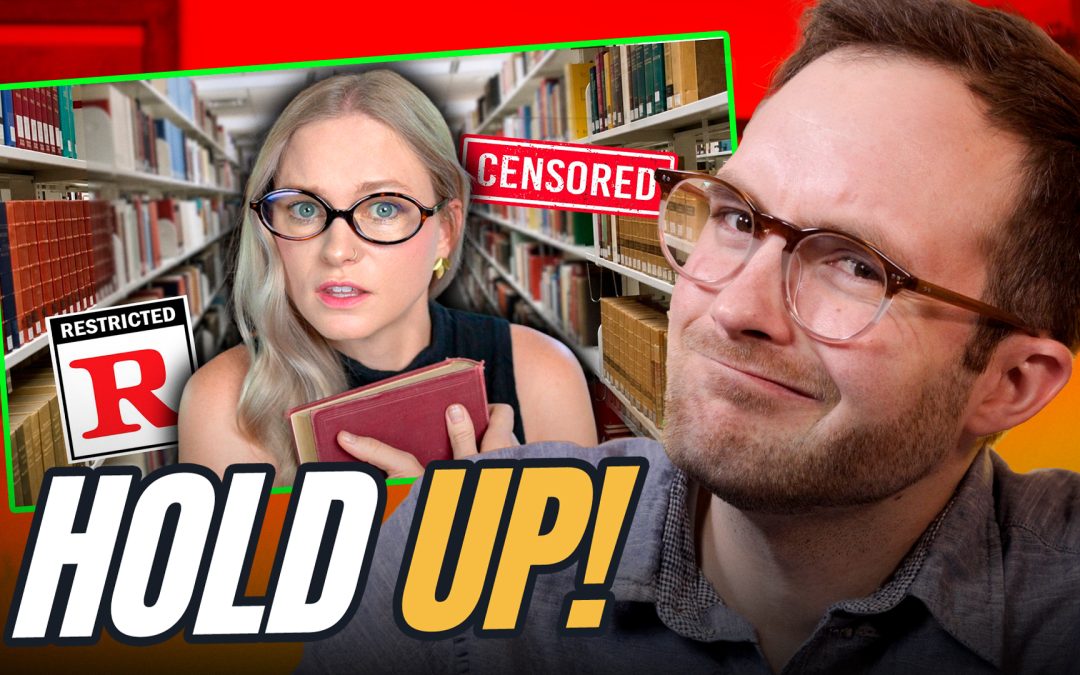
Alyssa Grenfell, a former member and popular critic of The Church of Jesus Christ of Latter-day Saints, recently launched a full-on attack against the BYU library.
Let’s take a look at some of the claims.
“What does a Mormon library do with exmormon books? … if you look up Bad Mormon by Heather Gay, they do actually have her book, but it’s in a restricted area of the library … You have to go to a special reading room and someone will watch you while you read the book the entire time.”
That “restricted section” of the library is called Special Collections. Lots of university libraries have one. This section at BYU preserves hundreds of thousands of rare books, thousands of manuscripts, over one million photos, and all kinds of other cool stuff. As per the website, special collections materials are accessible to “students, faculty, and the general public.” This is what the reading room looks like. You fill out a quick request form and usually a student employee will deliver you your materials through this window next to the desk. There are security cameras in the reading room. Again, that’s normal. People have stolen things in the past. Some universities do actually put an employee in their reading room who will watch you, but BYU actually does not do that.
I have used the reading room multiple times in the past, and nobody was ominously standing over my shoulder watching me read.
“The book Devout by David Archuleta is also restricted, so you also have to read this in the special reading room. You cannot check it out, you cannot take it home.”
OK, let’s test this claim. If we go to the BYU Library’s website and type in David Archuleta’s book, these are the results. So, yes, it looks like there is a copy for on-site use only in Special Collections … but if you click this little button here on the library’s website, you can see that there is a second copy of Devout that is available for students to check out and take home. In fact, it looks like someone has checked it out and taken it home. So this creator’s claim about Devout is verifiably false.
“And if you go to the special collections website it says that this area of the library is specifically to preserve and house materials requiring great care to protect and ensure their proper long-term use. So even though it sounds like special collections is meant to house books that are basically antiques, I think we all know what books like devout and bad mormon are doing in that restricted area.”
Yes, we do know why they’re there, and it’s (perhaps not surprisingly) much less sinister than this creator makes it out to be. The rare books and artifacts, in my opinion, are the coolest items housed here, but the library’s own video about Special Collections can shed some additional light on this claim:
“The primary types of documents are rare books and manuscripts … the oldest item is a cuneiform tablet circa 2000 BCE. The newest items include books published this year.
OK, so the library openly acknowledges that even newer books are also sometimes stored in Special Collections. Why? Is it to make some materials harder for students to access? No. It’s because oftentimes even new books are relevant to a special collection. If you look up Bad Mormon or Devout, you’ll find that they are all part of the Americana Collection within Special Collections. As per the website, “The Americana Collection is specific to areas of Mormonism, Utah, and the American West.” So why are Bad Mormon and Devout and any number of other pro-LDS and anti-LDS books in there? Because they’re about Mormonism, Utah, or the American West. It really is not that deep.
But I wanted to know as much as I could about Special Collections in preparation for this video. So I sent out some emails, one thing led to another, and the curator of Special Collections offered to take me on a private tour. You guys, there are literally thousands of books in the Americana Collection that are not antiques. I have seen them with my own eyes. I saw a huge Brandon Sanderson section, a huge Orson Scott Card section, and for better or worse, an entire shelf dedicated to the Twilight series. Oh, and yes, I even found Bad Mormon. But why is Bad Mormon in Special Collections and not on regular bookshelves?
Well, that’s exactly what I asked the curator over the open shelves for that area of the library. He responded…
“We focus on collecting academic works about the Church and its members. I rarely purchase what look to be polemical works, either positive or negative. These are just outside our collecting policies to support curriculum … Knowing the university has a copy for researchers [in Special Collections] is sufficient to me in these cases … in my mind, if anyone wanted to censor this material for whatever reason, we wouldn’t get a copy at all; however, I’m not familiar with any instance of this happening.”
You guys, as I emailed back and forth with library employees and talked with them in-person during the tour… I cannot tell you how little they care if you want to read anti-Mormon or ex-Mormon books. And one of the things I noticed from this creator’s video was that time and time again, it seems like she disproves her own claims. But she tries to find a reason to downplay it, and still make it seem sinister.
Does this Mormon library have the ex-Mormon book, Bad Mormon? Well, yes, yes they do, but it’s in the restricted section, which the general public has access to. But what about the ex-Mormon book, Devout? Again, yes, and it’s even on the open bookshelves. This creator rightly points out that the library does not have a copy of her self-published book about leaving the Church, and she shows an old video of herself going through the library in disguise, looking for a place to leave her book.
The SP curator said they would have accepted it as a donation. But anyway, while she’s planting her book in her video, she shows an entire section of books about the history of Mormon polygamy. So she’s trying to make the case that the library is hiding controversial materials, and then she shows a whole section of books about one of the most controversial aspects of our faith that are just available for anyone to read. Of course, she explains this away as well by claiming these books are kept in some hidden part of the library that nobody goes to.
“I ended up putting it amongst all of these other books that were about polygamy. So I went and typed in polygamy, and I was like, let me see if they even have anything like this on the shelves. So down in the basement, uh, which was also kind of funny. It’s like nobody goes in the basement. So they kind of have even anything being in the basement in my opinion is like kind of hiding it from the rest of the student population because it’s in like a dusty dark corner off to the side … here some of the examples of the books I saw. So I was like, “All right, I’ll put it next to any books about polygamy because I feel like if anyone’s learning about polygamy, they’re probably questioning their belief.”
And by the way, these books are not hidden away in a dusty corner of the basement. They’re just included right where we would expect them to be in the religion section of the library. And as I was perusing the shelves, I also found literally six copies of one of the most controversial books about church history ever published, “No Man Knows My History,” by Fawn Brodie — all available for checkout. And interestingly enough, as I was looking through the classification system for the religion section, I found an entire section dedicated to “controversial works.”
This section included classic titles such as John D. Lee’s “Mormonism Unveiled,” Bruce Kinney’s “Mormonism: The Islam of America,” and more recent titles like James White’s “Letters to a Mormon Elder”. A very odd section to have, if you’re wanting to keep critical material away from students. But this creator disproves her own claims one more time later on in the video.
“I used to love going to the section where they had CDs because I would check out CDs and then I would download the music onto my computer and that was like a way to get free music.”
Pretty sure that’s illegal, but OK.
“So, one of the times that I was getting CDs, I saw they had the Book of Mormon musical … And I remember I checked it out as a joke to basically show my roommates and be like, “Haha, Book of Mormon musical.” But I did end up listening to it and downloading it and enjoying the music and thinking it was hilarious, but also feeling like it was contraband. And I remember one of my roommates coming home and seeing it out on the table and she said like, “Who whose CD is this?” because a lot of people consider the Book of Mormon musical to be uh along the lines of anti- Mormon propaganda … And I was like, “Oh, I got it, but like as a joke.” And I also I remember at the time I said, “I got it from the BYU library.” And I remember feeling like that was like my free pass to say like, well, I’m allowed to have it because if the BYU library has it, then am I not allowed to just check it out because they’re the ones who decided to put it in the library?”
I’m not sure how this helps her argument. By checking out the Book of Mormon Musical CD, she’s providing even more first-hand evidence that BYU is not trying to hide critical material from students. Of course, she explains this by suggesting that the music curator must have just been more open to critical material than the Special Collections curator.
… we have the librarian who put Book of Mormon musical on the shelves and then we have the librarian who chose to put these ex Mormon books in special collections. And I think the reason this is an interesting comparison is that these are two different types of person. I think the librarian who chose who’s probably the the music librarian who’s doing the acquisitions of the CDs is potentially a different person who decided to get these books and put them away hide them away from the students.
I don’t think this is a great comparison, because both librarians are acquiring these materials to make them available for people to access. Yes, security is tighter for Special Collections, but that’s just so people don’t damage or lose or steal collected materials. And by the way, that CD is actually still available for checkout at the library today. So ultimately, the question I’m left with is: What evidence does she actually present that backs up her case? Because it seems to me that most of what she shows actually supports the opposite conclusion.
In any case, she wraps up her video with a biting quote about truth.
“And I guess as a final note on censorship, I am going to read a quote from George Orwell who wrote 1984. He said, ‘The further a society drifts from the truth, the more it will hate those who speak it.’”
You guys, George Orwell never wrote that. As per Snopes.com, that quote comes from columnist Selwyn Duke, in an article from 2009. Ultimately, it seems that this creator’s goal in this video — if I may actually quote George Orwell — was “to give an appearance of solidity to pure wind.”
Guys, if you liked this video, you’ll love this one in which an Evangelical pastor and I react to controversial videos made about our respective faiths. Go check it out. I’ll see you there.