
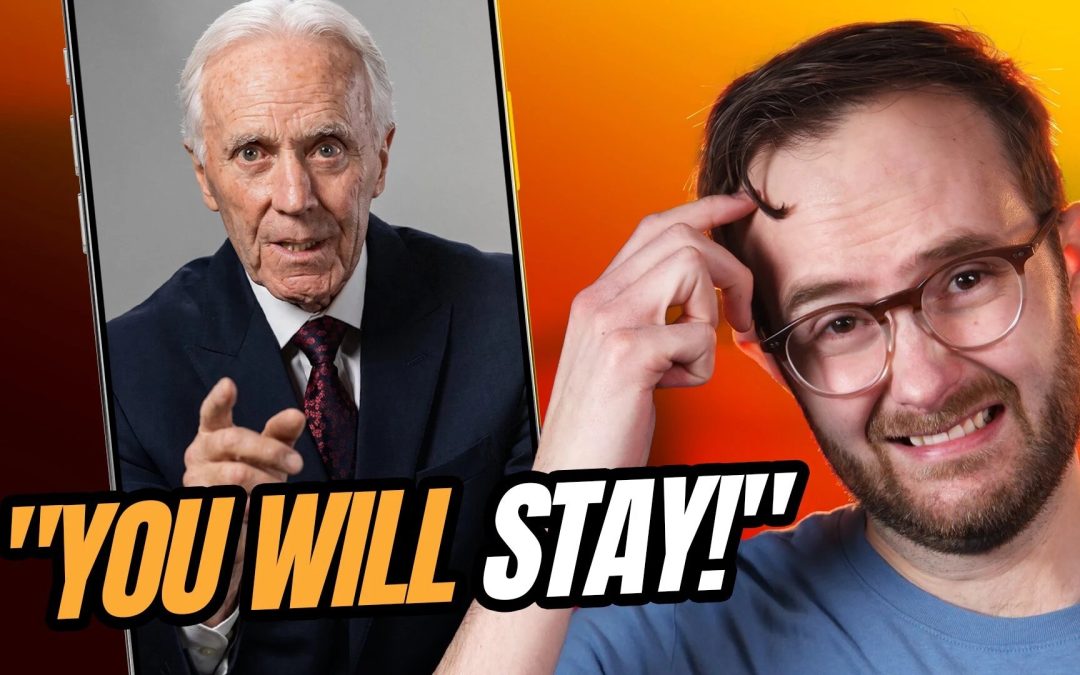
To watch this episode on YouTube, click HERE.
Some people are calling it amazing and powerful. Others are calling it incredibly damaging and the worst video they’ve ever seen.
Before I tell you where I land on this, let’s see what all the hubbub’s about.
“Darth Vader could be your bishop. The culture could be like Alcatraz, and it will not drive you away. Some claim church culture is driving people away—that members feel unseen, disconnected, empty and the solution they say is a transformation to a more open, inclusive, transparent, loving and tolerant culture wherein more people can comfortably gather. The ultimate question is not “Do I fit in?”. The ultimate question is, “Is the church true?”. None of this is to say we should stand idly by as people walk out the door with broken and lonely hearts thinking there’s no place for me here. I don’t belong here. But belief trumps discomfort. If viewed from the institutional perspective, then those arguments for leaving make sense. If you see the church as the kingdom of God on earth, then you will stay, come what may.”
OK so,
Elder Corbridge is an emeritus member of the Quorum of the Seventy.
You probably remember his fantastic “Stand Forever” BYU speech from several years ago, which has since turned into an entire video series on Scripture Central. And these clips come from one of those longer videos that I think is absolutely worth watching. LDS creator Greg Matson loved the reel. He did a whole write-up about how many Latter-day Saints today are trading truth for niceness, and Elder Corbridge’s bluntness was refreshing. Our friends over at Latter Daily Saints were also all for it:
“I’m one of these people that saw this ‘controversial video,’ and I’m like… ‘where’s the controversy?’”
Other people thought the video was tone-deaf, and while it might feel reassuring to members who are already all-in, it felt marginalizing to people who are struggling.
Here’s what Cardon Ellis over at Ward Radio had to say about it:
SOT Cardon Ellis: “And the trend kinda seems like you’ve got an older out of touch generation victim blaming those who are struggling … and then you freaking have a guy that says ‘you will eat your mush. You will eat your mush, and it’s healthy for you. And if you don’t eat it there’s something wrong with you.”
Needless to say, there’s a divide. Here’s the deal:
I have written and rewritten and revised my thoughts and response to this video more times than I can count at this point. There are some tight needles I’m trying to thread, but I’m just going to be honest with where I’m at with it, and you can take these thoughts for what they’re worth.
First of all, I really like Elder Corbridge. I don’t think he was intending to cause harm in this video. I think he cares deeply about the gospel and deeply about people. I agree that if the foundational truth claims of the Church are true — if the Book of Mormon is true, if Joseph Smith was a prophet, if priesthood authority was restored and this is the Kingdom of God on the earth today, then it doesn’t make sense to leave the Church over cultural issues. Elder Corbridge’s framework actually resonates deeply with me.
A rude bishop or an unwelcoming ward does not change absolute truth. But I think one of the pressure points is in the premise itself — because I’d argue that most members don’t actually know the Church is true, absolutely. For most people, myself included, it’s a matter of faith. It’s a choice — a decision each person has to make based on the temporal and spiritual information available to them. So while secondary questions are less important than primary questions, I think it’s understandable that secondary questions can either reinforce or chip away at your faith in those primary questions over time.
For many people, primary and secondary questions are entirely separate categories. But for many others, they are intricately intertwined with each other. Their lived experiences, spiritual or otherwise, factor into where they choose to place their faith. Positive and negative experiences aren’t just footnotes that everyone can simply separate from testimony. For many people, they’re data points being placed on the scales of testimony. I think there are logical grounds for that framework — even if I may personally disagree sometimes with the conclusions it leads some people to.
After all, whether or not you believe something doesn’t actually change whether or not it’s true. So I guess what I’m saying is that I think that what Elder Corbridge is saying looks great on paper, but real life is often more complicated than that. Now, one of the things some people loved about the video was just how direct and forward Elder Corbridge was. For example, Greg Matson wrote that “A truth can be delivered directly and still be true. Just like a diagnosis can be unwelcome and still be accurate. The critics have mostly argued that Corbridge is unkind, and then acted as though they’d shown he was mistaken. They haven’t.”
I agree that truth directly delivered is still true. But I would also add that a direct truth isn’t always a helpful truth. For example, I agree with the idea that “truth trumps discomfort,” but I also believe that that’s not always a helpful statement. I think it risks alienating people who are uncomfortable even more. I’m not saying we sacrifice truth for comfort, but how we use truth matters. Perhaps a more helpful mindset might be, “Because the Church is true, we should care deeply about the individuals who are having negative experiences in the Church.” Because the Church is true, we should be helping everyone to feel like they matter, because they do!
In Alma chapter 4, we read that “the wickedness of the church was a great stumbling block to those who did not belong to the church; and thus the church began to fail in its progress.” I don’t think that’s happening on a large scale right now, but because the Church is true, let’s try to remove any frivolous obstacles that are preventing people from getting to that truth. If a tree falls across the path of discipleship, let’s get the chainsaws out and get to work. I’m not suggesting we devalue or compromise truth claims, but if there are ways we can clear a more direct path to those truth claims, I’m all for it.
I agree that the question “is the Church true?” should carry monumental weight. But it’s not the only important question people are grappling with. People are also asking, ” Can I spiritually thrive here? Can I feel good about raising my children here? Is the institution living up to the core truths it espouses?” I’m not saying that it’s the Church’s fault or the culture’s fault or the people’s fault any time someone leaves the Church. People are accountable for their own decisions. But because the Church is true, I think we should be sincerely engaging with all of those questions. Because the Church is true, our primary focus should be on becoming like Jesus Christ, not just becoming more institutionally loyal — as important and relevant as that is.
Truth tells us what is true, but oftentimes it’s experience that tells us what needs attention — what needs work. Now, to a lot of people, that might sound like I’m inching towards trading truth for niceness. And that is actually a claim I hear pretty often about my content. Some people feel like I sacrifice conviction to help people feel comfortable. I am constantly trying, imperfectly, to strike the right balance between truth and love. Or trying to be bold but not overbearing, as the Book of Mormon teaches. I’m not saying that people need to be treated like delicate snowflakes. I’m not suggesting we need to water down the gospel for the sake of comfort. It’s not about activism or being a progmo — it’s not about politics. I can’t stand politics.
The reality is just that in order to be effective disciples of Jesus Christ, we often need truth and more. In fact, that’s the title of a speech given by President Russell M. Nelson back in 1985.
“Just as oxen may be equally yoked together to accomplish what one could not do alone, so the power of truth is augmented if equally yoked with righteousness or with mercy or with the spirit of love … Truth, like justice, can be harsh and unforgiving when not tempered by mercy.”
“My experiences as a surgeon taught me the remarkable potential for truth. It is a powerful sword—an instrument that can be wielded just like a surgeon’s knife. It can be guided well to bless. But it can also be crudely applied to wound, to cripple, to damage, or even to destroy! May I give you an illustration? Imagine a surgeon who has just operated upon a patient and found cancer invading vital organs of the body. It is widespread and beyond cure. With this knowledge, the surgeon approaches the family and the patient and coldly announces that the patient has advanced cancer, that he is beyond hope and is doomed to die. While discharging his duty to share that information, the surgeon has told the truth, but with utter abandon has then walked away from the turmoil that “truth” has left in its wake.
Another surgeon, with that same information and with compassion, approaches the family, speaks the truth, and then mercifully indicates that, even though the road ahead will be difficult and challenging, the patient and the family will not be forsaken. They will be supported with all the resources available to him as their caring physician.
Important as truth is, often we need truth and more.” President Oaks taught something very similar just a couple of years later, which you can pause and read.
“Truth surely exists as an absolute, but our use of truth should be disciplined by other values … Just as the principle of justice must be constrained by the principle of mercy, so must the use of truth be disciplined by the principle of love.
My wife and I recently watched the Divergent movies. They’re about this post-apocalyptic society that divides people into factions based on their most dominant personality trait. One faction is called Amity — they’re defined by their kindness and compassion for others. Another faction is called Candor — they always tell the truth, even if it’s brutally honest. The hope of society becomes a group of outcasts called the Divergents. These are people who don’t fit cleanly into any single faction. They embody multiple traits at once. It’s cheesy, I know, but I think as members of the Church, we need to be Divergents, in the sense that we need to be very familiar with both truth and love. Because there can be danger at either extreme of the spectrum. But I’m also not saying that we need to be perfectly in the middle of that spectrum all the time either.
The ideal scenario is that we strive to be in tune with the promptings of the Holy Spirit, which can help us determine where on the spectrum we need to be at any given time. Sometimes we might need to float like a butterfly. Sometimes we might need to sting like a bee. I’m not entirely confident I used that phrase correctly, but you know what I mean. We need to meet people where they’re at, but also not just leave them there. Like the Good Samaritan, we need to have compassion for the wounded, but we also need to pick them up and help them heal. So clearly, I think there’s a lot of nuance to this subject. We’re not just dealing with truth claims, we’re dealing with people, and that can get complicated sometimes. But because the Church is true, we don’t give up. We don’t give up on the truth claims or the people.
Now, I can’t be sure, but I get the feeling that Elder Corbridge’s video was at least partially in response to the work of one of our previous guests, Jeff Strong. Jeff’s work focuses a lot on addressing cultural issues in our faith. And I think Elder Corbridge wanted to remind people that while cultural issues matter, whether or not the Church is true matters more. But if you’re interested in hearing Jeff’s perspective on culture, go check out our interview. It’s one of the most popular videos on our channel, and I’ll see you there!