
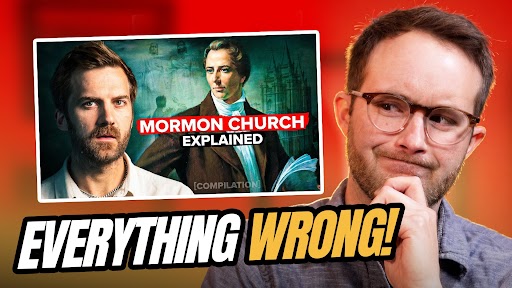
To watch this video on YouTube, click HERE.
Video Transcript:
Popular YouTuber and former Latter-day Saint Johnny Harris has published 3 videos about LDS history. We have responded to all 3 of them. But recently, he took his 3 videos and published them together as one long video. So we went through our responses and made some important updates. I like Johnny — I think he’s a sincere guy, and he’s much more responsible in his videos about our faith than I’ve seen some others be, but there are still quite a few issues that I think are worth addressing:
EP 1:
**JH Treasure-digging segment**
OK, so I actually love talking about Joseph Smith and treasure-digging. Many critics portray Joseph’s treasure digging and this “magical worldview” as either witchcraft or outright fraudulence. Either way you go, it doesn’t look good for Joseph Smith. It’s a great way to sort of poison the well and prime your audience to believe that Joseph was either a liar or deceived.
But the reality is that, according to the non-Latter-day Saint historian Alan Taylor, “Treasure hunting was explicitly a form of Christian folk-religiosity as practiced in upstate New York and New England. For many rural Yankees, ‘treasure-seeking was a materialistic extension of their Christian faith. …’”
The folk-belief was that if someone buried their money and then died without using it righteously, their spirit was bound to that money until someone found it and put it to good use. They believed that evil spirits would try to prevent them from finding the money — they’d cause it to sink deeper into the ground, etc. But sincere believers felt they were essentially liberating spirits from purgatory by digging for treasure. Another non-Latter-day Saint, the anthropologist Manuel Padro, wrote that “If this were among the Smith family’s motivations, then we have misread the morality of their involvement in this practice.”
Mainstream Protestantism at this time wasn’t a big fan of this folk-christianity because it resembled some old Catholic beliefs and practices, so, as Padro found, Protestants “condemned these folk-Christian practices as demonic and witchcraftery.” Anyway, I don’t think it was nearly as diabolical as some people make it out to be.
**Marionette graphics**
OK, so I just want to call attention to the animation style here. It’s kind of uncanny and creepy — almost like he’s a marionette puppet. It might seem like a little thing to nitpick, but the lighting and graphics — that all contribute to the feel of the video, and the feel it creates is that there is something dark or unnatural happening. And as someone who views this story as miraculous and beautiful, I think that’s too bad that they went that route with it.
**That no one is allowed to see**
OK, so initially, this is true that people weren’t allowed to see the plates, but I think it’s extremely misleading not to bring up the 11 witnesses here who did see the plates after the translation was complete. Their testimonies can be found in literally every copy of the Book of Mormon. And there are also a handful of unofficial witnesses who had amazing experiences with the plates as well. For me, this is probably the biggest problem with this entire video. If it’s just one guy claiming to have these plates that nobody else ever saw, that’d be one thing. But as soon as all of these other people are like, “Yeah, I saw them, he showed them to me,” it gets a lot more difficult to shrug Joseph’s story off. Johnny completely side-steps this topic in this video, which is unfortunate. But, I get it! It’s not easy to explain what they experienced if it wasn’t real. The best explanation that even well-known critics like Fawn Brodie and Dan Vogel have come up with was that Joseph Smith somehow hypnotized all of these people, which I think is just kind of wild.
Anyway, I’d love to talk about the witnesses for another hour. I think they are a formidable obstacle for those claiming that Joseph was a fraud. It’s a shame they’re not mentioned here.
**Sit on one side of a curtain**
Did Joseph actually dictate the Book of Mormon from behind a curtain? So I’m going to extend some grace here; I understand where this claim is coming from. And we even have Church art portraying the translation this way. But when you look at the historical accounts of the translation, I think there’s a different picture being painted — and this is something that Gerrit Dirkmaat and Michael MacKay talk about in this book. Long story short, before the translation began, Joseph copied down characters from the plates, probably from behind a curtain, which Martin Harris then took to Charles Anthon. Later accounts of the translation of the text we have today, which you can pause and read, indicate that there was no curtain — that Joseph would look at his seer stone or stones in his hat, with no access to notes or reference materials, and dictate the text in front of whoever happened to be there at the time. Now, that doesn’t prove Joseph was a prophet, but it does make it a lot harder for people to claim that he was doing anything suspicious from behind a curtain. Johnny leaves the door wide open for people to make assumptions, but it’s very likely not accurate.
**Changes intro from “principal” to “among the ancestors”**
OK, so a while back I had someone message me about this change in the introduction to the Book of Mormon, and they thought that the introduction was part of the original ancient text that had been translated, which is an understandable misunderstanding. But for the record, no, the introduction was added later to help new readers better understand what the Book of Mormon is about. I think leaders came to understand that the Nephites and the Lamanites were probably not the only civilizations in the Americas at this time, and the Book of Mormon ends with the Nephites extinct and the Lamanites warring with each other. So I think it was a good move to essentially say, well, we don’t know for sure how big a slice of the ancestral pie these people take up, but they’re in there somewhere. Frankly, I’m grateful to belong to a Church that is willing to adapt as new light and knowledge come forth.
**Archaeology stuff**
Oh boy there’s so much to say about this but I’m going to limit myself to two points:
Old World archaeology is a totally different animal from New World archaeology. The desert preserves things very well. The jungle does not. Edwin Barnhart, who is the director of the Maya Exploration Center, said that “Less than one percent of Mesoamerica has been professionally surveyed.” In 2015, archaeologist William Saturno said, “Of all of the Maya sites that we know to exist, we have excavated less than 1 percent of them… The sites themselves that we’ve done excavations at we’ve excavated less than 10 percent of 1 percent …we’re still just scratching the surface.” I especially love this quote from the director of the Center for Maya Research back in 2013: “Truth is, we don’t know squat.” With lidar technology, researchers are literally finding entire cities under the jungle canopy that they didn’t know existed.
That said, if you look at the brief segment of the Book of Mormon that does occur in the Old World, there’s actually some really captivating finds. The description of Lehi’s journey from Jerusalem to the sea is totally plausible. They mention a site called Nahom — lo and behold, there is an ancient site called Nahom out there. They’ve even found a plausible burial site for Ishmael. But the New World is different. We don’t know where exactly to start looking, and we don’t know how much evidence would even be left that would be identifiable.
I totally understand why a lack of archaeological evidence is a challenge for some people, but I do sometimes think that people might overestimate how much work has actually been done in the New World.
- I think that when it comes to the Book of Mormon and the miraculous claims in the Bible… I think God wants people to believe because they resonate with the teachings, not because they’re overwhelmed by the academic evidence. I think He wants people to make a choice. So, frankly, if the Book of Mormon is true, I don’t expect to find overwhelming evidence, and the same thing applies to the Bible.
**”He’s now talking to God directly all the time”**
Um, no. We don’t believe he was talking with God directly all of the time. He was receiving revelations from time to time, but revelations can come in all sorts of different ways. One of our apostles, Elder David A. Bednar, taught that “Sometimes the spirit of revelation will operate immediately and intensely, other times subtly and gradually, and often so delicately you may not even consciously recognize it.” Some people portray Joseph Smith’s revelations as if he were having regular brunch appointments with God and taking down dictation. Joseph certainly did experience some striking heavenly visitations, but I think that was more the exception than the rule.
**Closing thoughts when Johnny claims Joseph was just a good storyteller and invented the BoM**
OK, so Johnny is absolutely allowed to come to his own conclusions on this. That said, I feel like this is where he starts to stray especially far from the available historical evidence. We’ve got this 531-page book. We can read it and see with our eyes how complex it is. We can analyze the statistically unique literary voices, we can check for contradictions, and we can see the intertextuality. And we can pair that with the historical evidence available about its coming forth — the speed of the dictation, the lack of notes and reference materials, the witnesses who saw the plates. I take what I know about the Book of Mormon, and I put that up against what I know about Joseph Smith and the skills he had, and I see a vast gap between the two that I don’t think can be filled by just saying, ” Oh, well, he was just a charismatic storyteller. That might work for some people, but for me, that does not answer the questions that I need answered.
Guys, if you found this response valuable, I highly recommend you also check out our response to what comedian Mark Gagnon had to say about our faith. He actually saw this response video and let me give him some feedback on a later video he did on our faith. Huge respect for him. I’ll see you there.