
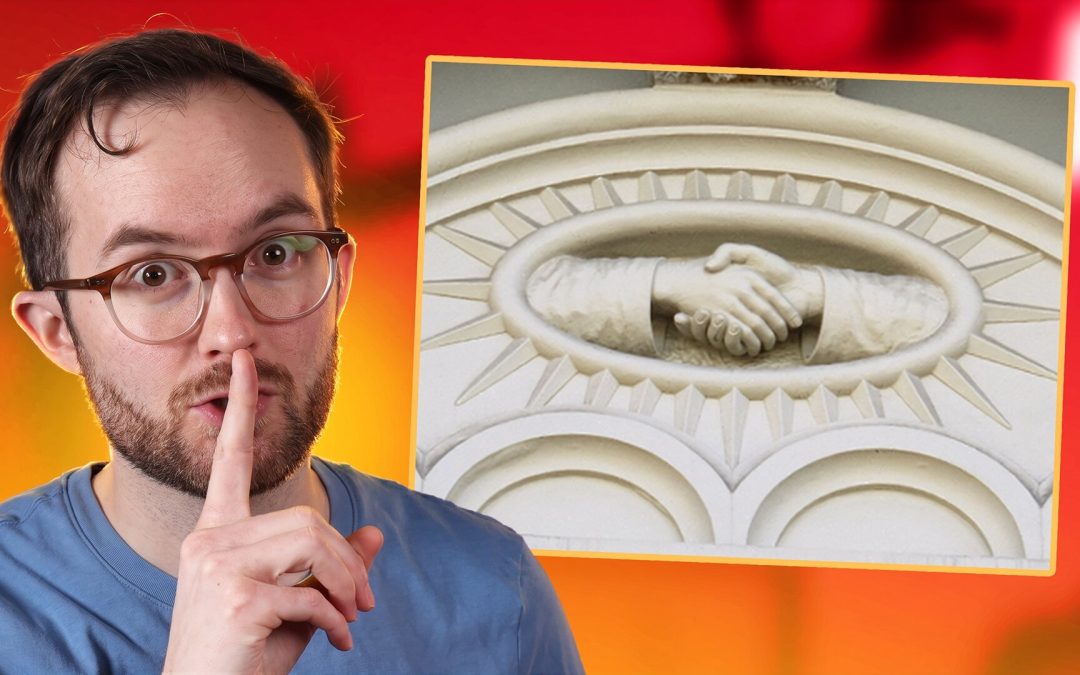
To watch this video on YouTube, click HERE.
Video transcript:
We need to talk about temple signs and tokens.
Kind of.
You see, the signs and tokens of the Holy Priesthood are some of the very few pieces of the LDS temple endowment that members specifically promise not to reveal outside of the temple. So today we’re going to try to thread the needle and respectfully talk about what we can, while of course not revealing anything we’ve promised to keep sacred. Because the reality is… I’ve had questions about this topic for a long time. And most of them start with this quote from President Brigham Young:
“Your endowment is, to receive all those ordinances in the House of the Lord, which are necessary for you, to enable you to walk back to the presence of the Father, passing the angels who stand as sentinels, being enabled to give them the key words, the signs and tokens, pertaining to the Holy Priesthood, and gain your eternal exaltation in spite of earth and hell.”
There is a lot going on there. Angels standing as sentinels. Key words. Signs and tokens you have to give the angels to get through. I’ve heard that quote countless times, and for years I’ve wondered… is that literal? Is there really some kind of checkpoint waiting for us after this life, where we need to remember the right words and gestures to get into heaven? I didn’t know, so I got to work.
The first thing I wanted to understand was what the function of a “sign” or “token” even was to begin with. That’s when I found this book by BYU professor Alonzo Gaskill. He wrote,
“In the temple, we use many symbols as a means of conveying doctrinal ideas. Signs and tokens are just religious symbols that are part of the temple endowment.”
And interestingly, when I looked up the etymology of the word symbol, I found that it comes from Latin and Greek words meaning token or sign. The Greek word for symbol — symbolon — actually referred to a “token of identity verified by comparing its other half.” Anciently, a piece of pottery, wood, or some other object could be split or broken into two pieces, and a half would be given to each party in an agreement.
Later, these tokens could be produced as proof that there was, in fact, an existing relationship between those parties. And we’re going to circle back around to this idea, but as I was trying to learn more about what signs and tokens symbolize, I found myself in the Old Testament. A lot of what we experience in the temple endowment is related to the book of Genesis. The Creation, the Fall of Adam and Eve, etc. And sure enough, Genesis also includes multiple references to signs or tokens. For example,
“This is my covenant which you shall keep, between Me and you and your descendants after you: Every male child among you shall be circumcised … and it shall be a sign of the covenant between Me and you.”
So the sign was a symbol that identified the individual as part of God’s covenant community. But as I kept digging, I found there’s more to it than that. After the great flood, God makes a covenant with Noah and with the whole world:
“I have set my rainbow in the clouds, and it will be the sign of the covenant between me and the earth.”
That’s the NIV. The King James Version uses the term token instead of sign. And what purpose did this token serve? “Whenever the rainbow appears in the clouds, I will see it and remember the everlasting covenant between God and all living creatures…” So now I had two functions. Covenantal signs and tokens are identity markers, and they are also physical reminders of the covenants they are associated with. Now, the more I looked into this subject, the more I ran into an objection that deserves some airtime.
The Church’s own website acknowledges there are similarities between the temple endowment and Freemason ceremonies — and that even applies to some signs and tokens. I understand why this is a problem for some people. Personally, I’m not bothered by the similarities, because God has been adapting pre-existing symbols for His use for thousands of years. And circumcision is a great example of that. Abraham did not invent circumcision. It was already a practice in the ancient world, one Abraham would likely have encountered just from living in Canaan and visiting Egypt. But it was adapted to symbolize something new. Inspired adaptation, not invention from scratch, seems to be par for the course with God.
So I kept digging, because identity markers and reminders — that’s great, but that’s not actually what was bugging me. Brigham Young wasn’t just talking about identity markers. He was talking about passing by guardian angels standing as sentinels. And I still wanted to know… how literal is that process meant to be? Yes, they’re symbols, but will they actually be literally presented at some point after this life?
I think this might be an area where different church leaders and members might have different opinions. As for me, the conclusion that I have come to is that it’s probably not a literal presentation process. Let me explain. When I was younger, I would go through the endowment, and there was a part in the presentation where Adam would shake hands with a premortal apostle. And I remember thinking, well, hang on, how did they shake hands if the apostle was just a spirit and didn’t have a physical body yet? And what I’ve learned since is, they probably didn’t actually shake hands.
The temple endowment is a ritual drama. It’s a story that we are participating in. When the temple represents the past, we need to be careful not to assume that everything we see or do happened exactly that way historically. Instead, we need to be asking what the overall meaning is. What are we supposed to take away from this? Similarly, when the temple represents future events, I think we likewise need to be careful not to assume that everything we see or do is exactly how it will happen in the future. So I think that the presentation of signs and tokens is most likely a powerful narrative tool, rather than a preview of specific future events and processes.
But Apostle John Widtsoe taught that “No man or woman can come out of the temple endowed as he should be, unless he has seen, beyond the symbol, the mighty realities for which the symbols stand.” If the signs and tokens are a symbolic narrative tool, what are the “mighty realities” for which they stand? Is there more to it than what we’ve already uncovered? Well, I think I found another piece of the puzzle in a quote from apostle Delbert Stapley back in 1961. He said,
“Every person is to receive his or her endowments in the house of the Lord, which permit them, if faithful and true, to pass by the angels who stand as sentinels guarding the way….”
If faithful and true. That’s the piece Brigham Young’s quote doesn’t spell out, but Stapley does. The signs and tokens aren’t the point. There are plenty of “temple expose” videos online where people can learn the signs and tokens — but what really matters is being faithful and true to the covenants these signs and tokens are associated with. I wanted to understand this idea a bit better, so I called up BYU-Idaho professor and podcast host Scott Woodward, and he put it this way:
“Like many elements of the endowment, these signs and tokens are ultimately symbolic, right? At minimum, they represent fidelity, honoring commitments, and faithfulness. So in other words, the temple is not teaching us that people are going to be kept out of God’s kingdom because they forgot to say the right words or make the right symbolic gestures. What it’s really doing is emphasizing the importance of covenant keeping. So, while it’s very unlikely that these symbolic actions and words themselves are going to play any role in the afterlife, our faithfulness — our commitment keeping, our fidelity to our covenants — certainly will.”
The signs and tokens are not about memorization, or receiving secret hidden knowledge — they’re about faithfulness to God and our covenants with Him. And once I understood that, something clicked about what this part of the temple is actually depicting. In another episode, we talked about how our progression through the temple, in part, represents our journey from the fallen world back into the Garden of Eden, or back into full relationship with God. When Adam and Eve were expelled from the Garden, God left behind an angelic sentinel to guard the way back.
From a narrative standpoint, it makes sense that as we progress through the temple symbolically back into the Garden of Eden, we are equipped with a way to pass by that barrier before entering God’s presence. But ultimately, in our modern temples, that guardian at the gate is represented to be God himself. And as I thought about what this moment represents in our cosmic story, I realized that it is a recognition and reunion scene.
It’s the part where Frodo reunites with the fellowship at the end of the journey. The part where Nemo finally finds his dad. It’s the part where the loving father welcomes the prodigal son or daughter home. It’s not presented that emotionally in the temple, but I think that’s what this part of the temple story is.
As you can tell, I love movie references, and as I was thinking about this concept of recognition scenes I found an example that actually runs surprisingly parallel to what I think is happening in the temple. It’s admittedly a little sappy, but it’s from one of the best princess movies of all time: Anastasia. In the movie, Anastasia is trying to find her long-lost family. Near the end (spoiler alert), Anastasia and the Queen (her grandmother) exchange certain signs and tokens that help them recognize their true relationship. Take a look.
[SOT Anastasia clip]
Of course, God already knows who we are, but ultimately, I think this is a big part of the narrative function of the temple signs and tokens. It’s not about secret passwords and handshakes. It’s not transactional. It’s relational. We are symbolically reconnecting with our Heavenly Father. After an arduous mortal journey, we are finally coming home.
I don’t know that I can think of a moment more holy, more joyous, and more sacred than that one will be. Now, a minute ago, we talked about how the temple is, in part, a symbolic journey back to the Garden of Eden. If you want to flesh that out a bit more, which I hope you do, go watch this episode, and I’ll see you there.