
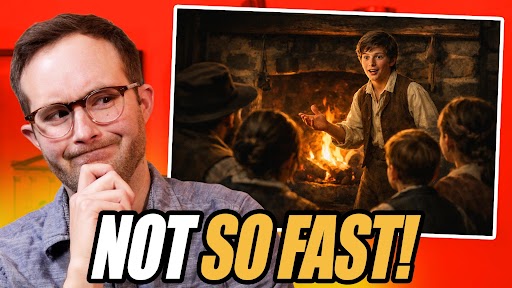
To watch this episode on YouTube, click HERE.
Video Script:
A top Exmormon Reddit user claimed that “Joseph [Smith] was supposedly regaling his family with BoM-style stories long before he received the plates/saw Moroni/etc.” The suggestion here is that Joseph Smith just had a great imagination and that the Book of Mormon is just a story that he made up. Here are 3 problems with that claim.
Problem #1: Lack of context
When people claim that Joseph Smith was just a good storyteller, they almost always point back to the same source. Remembering Joseph as a young man, Lucy Mack Smith wrote, “In the course of our evening conversations, Joseph gave us some of the most amusing recitals which could be imagined. He would describe the ancient inhabitants of this continent, their dress, their manner of traveling, the animals which they rode, the cities that they built, and the structure of their buildings with every particular, their mode of warfare, and their religious worship as specifically as though he had spent his life with them.”
Now, how could Joseph know about this kind of stuff before the Book of Mormon was even translated? Many critics will rely on your imagination to answer that question instead of just giving you the context.
Joseph Smith claimed that on the night of September 21st, 1823, he was visited 3 times by an angel named Moroni. The content of each visit was relatively the same, but these visits took up the entire night. He was told about the golden plates, and that God had a work for him to do, but Joseph said, “I was also informed concerning the aboriginal inhabitants of this country, and shown who they were, and from whence they came; a brief sketch of their origin, progress, civilization, laws, government, of their righteousness and iniquity … was made known unto me….” In short, Moroni told Joseph about the plates, but he also told him about the history he would find on the plates.
The angel appeared again with the same information later that day. Joseph told his father about everything that had happened, and then later that evening, he told his whole family. His brother, William, remembered, “After we were all gathered, he arose and told us how the angel appeared to him; what he had told him… and that the angel had also given him a short account of the inhabitants who formerly resided upon this continent, a full history of whom he said was engraved on some plates which were hidden… The whole family was melted to tears, and believed all he said.”
Lucy adds, “We sat up very late and listened attentively to all that he had to say to us, but his mind had been so exercised that he became very much fatigued.” The family called it a night and decided to have Joseph continue his report the following evening.
Lucy said, “From this time forth Joseph continued to receive instructions from time to time, and every evening we gathered our children together and gave our time up to the discussion of those things which he instructed to us.” It is within this context, just a few sentences later, that we get the controversial paragraph in question.
Lucy was not admitting that Joseph was an imaginative storyteller; she was saying that Joseph was relaying information that had already been given or shown to him by Moroni in their various visits. She didn’t consider these family meetings to be problematic or evidence of fraud; she considered them to be part of the miraculous story of the coming forth of the Book of Mormon.
If you want to believe that a 17-year-old Joseph Smith was just making all this up and seeing if his gullible family would buy it, I can’t stop you, but for what it’s worth, that’s not what his family believed was happening. And that leads me to…
Problem #2: Lack of historical corroboration
Several prominent critics have repeated the claim that Joseph was a talented storyteller, but none of them cite historical sources to back that claim up beyond this one scenario. Dale Morgan boldly wrote that “Mormons and non-Mormon accounts alike agree that the youthful Joseph Smith had a remarkable imagination and a well-developed talent as a teller of tales.” But as researcher Brian Hales noted, “It is unfortunate Morgan provided no documentation to support this statement.”
A storyteller needs an audience. If “storytelling” was really one of Joseph’s favorite pastimes, wouldn’t we expect to see more evidence for this beyond this single scenario, which eyewitnesses didn’t even believe was Joseph making up stories? Early critics gathered dozens of affidavits from people in Joseph’s community in an effort to discredit him. They said all sorts of terrible things about him, but strangely, none of them claimed he was a known storyteller.
I worry that more modern claims to the contrary seem to be based more on wishful thinking than actual documentary evidence.
William Smith said that his brother “could not have conceived the idea in his mind of palming off a fabulous story, such as seeing angels, etc…. I suppose if he had told crooked stories about other things, we might have doubted his word about the plates, but Joseph was a truthful boy.”
Problem #3: Unexplained and contradictory evidence
For the sake of argument, let’s assume that Joseph Smith did indeed have a Walter-Mitty-esque imagination. That still would not magically solve the riddle that is the Book of Mormon. For example, various people saw, handled, and inspected the golden plates. 3 of those individuals were shown the plates by an angel. Joseph Smith having an active imagination does not explain what these witnesses saw, heard, felt, and testified of throughout their lives.
The storyteller theory also fails to explain the translation process of the Book of Mormon. There is a big difference between having a story in your head and committing it to paper. Joseph dictated all 269 thousand of these words with no reference materials available and no major revisions, with his face in a hat — all in about 60 working days, with no prior authorship experience.
The Book of Mormon expertly weaves together multiple timelines, hundreds of internally consistent geographic features, and intricate examples of intertextuality — in King James style English, which was not the way Joseph naturally spoke. Every detail in the Book of Mormon that is reliant on or related to another detail in the Book of Mormon was an opportunity to mess up. Even if he had years to mull it over, to perfectly execute that dictation day after day, and get all those details right, under those circumstances, in a book that is longer than the longest Harry Potter book, is remarkable.
And there are lots of other details that just don’t make a lot of sense if this were a story that Joseph just made up. When Joseph came to a name or a long word during dictation that he couldn’t pronounce, his wife said he would spell it out, as it appeared on his translation tool. If all of it came from Joseph’s own mind to begin with, there shouldn’t have been any names or words he couldn’t pronounce. She also said that Joseph was surprised to learn from the translation that Jerusalem had walls around it — suggesting that he was actively processing at least some of this information for the first time as it was being dictated.
People told scribe Martin Harris that Joseph was just repeating memorized sentences. To test that claim, Martin swapped out Joseph’s seer stone with a similar-looking stone. If Joseph was just making it up, he should have continued with the dictation as if nothing had happened. But he doesn’t. Instead, he’s confused and can’t translate a word until Martin finally fesses up.
I don’t at all think the “storyteller” theory is the smoking gun that some critics seem to think it is. Of course, believe whatever makes the most sense to you. I briefly mentioned the witnesses of the golden plates in this video. Despite their adamant testimonies, some people claim that they never actually saw the plates. If you want to dive a little deeper into that claim, check out this video. I’ll see you there!
Learning More:
— “Joseph Smith as a Book of Mormon Storyteller,” by Brian Hales in Interpreter Journal, Vol. 46, Article 16: https://tinyurl.com/3tajzafd
— “Joseph the Amusing Teller of Tall Tales: Lucy Mack Smith’s Puzzling Statement in Perspective,” by Jeff Lindsay in his blog Arise from the Dust: https://tinyurl.com/3n5xnz5m
—“Did Joseph Smith’s Mother Believe He Could Have Written the Book of Mormon?” by Scripture Central: https://tinyurl.com/ne6trr5w
— “The Book of Mormon ‘Author’ GAP” by Brian Hales: https://tinyurl.com/2zc2x8m2
— Report of Joseph’s visits with Moroni in Times and Seasons, 1 March 1842, pp. 707: https://tinyurl.com/25svwr2w
— “Father And Mother Believed Him; Why Should Not The Children?” by Dan Peterson in Patheos.com blog, Sic et Non, Nov. 27, 2017: https://tinyurl.com/2rfpa7f8
— “Naturalistic Explanations of the Origin of the Book of Mormon,” by Brian C. Hales in BYU Studies Quarterly, Vol. 58: Iss. 3, Article 5: https://tinyurl.com/mu9d5h3h
— For a great overview of intertextuality in the Book of Mormon, check out the book, “Voices in the Book of Mormon,” by John Hilton iii, or see the interview we did with him here: https://tinyurl.com/3c9dr6k5