
To watch this video on YouTube, click HERE.
Video transcript:
You guys, I have been learning so much about temples lately, and if I don’t tell you about it I’m going to explode. Modern Latter-day Saint temple practices hearken back in many ways to the ancient Israelite temple or tabernacle. You already knew that. BUT did you know that both of those traditions hearken back to something even older? We’ve got a lot to talk about so strap yourself in.
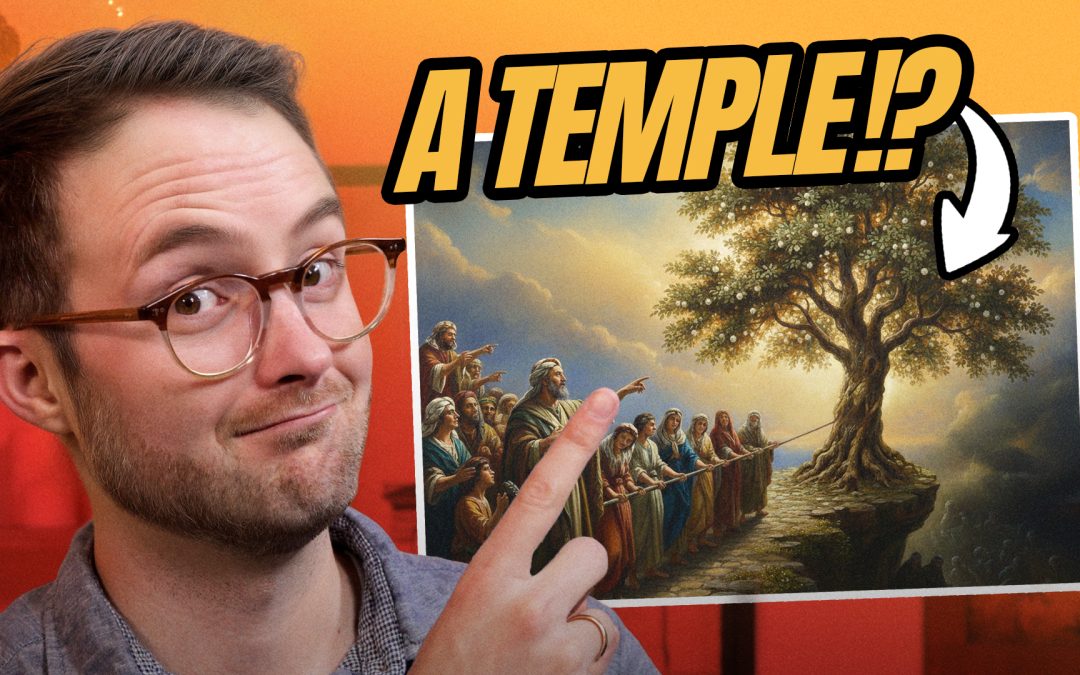
When ancient prophets didn’t have a physical temple available to them, where did they often go instead? That’s right, a mountain. Moses spoke with God in a holy space on Mt. Sinai. For Elijah, it was Mt. Horeb. Isaiah calls the temple the “mountain of the Lord’s house.” The Lord reveals himself to the Brother of Jared on a mountain in the Book of Mormon. Nephi was caught away to a “high mountain” where he spoke to the Spirit of the Lord and saw a vision of the Tree of Life — which we’re going to circle back around to at the end of this video.
You get the point. Mountains represent the space where heaven and earth meet. But… why? Why not a plateau? Or a waterfall? Or an island? Well my assumption used to be that mountains beat out all of the other geographic features simply because they were the tallest, and came closest to heaven, so to speak. And while that symbolism is meaningful, there’s actually more to it than that. But first we’ve got to go back. Way back. Back to the creation itself.
People from the ancient Near East thought about the Creation a bit differently than many of us do today. Today, we sort of imagine there being this empty void of nothingness which God filled with the earth, the planets, and stars, etc. But anciently, that empty void of nothingness was believed to actually be filled with just cosmic, chaotic water. Until, that is, God came along, and he created a space within that water. He created a firmament, or a solid dome, which “divided the waters which were under the firmament from the waters which were above the firmament….”
Then, at essentially the floor of this space under the firmament, He caused the land to emerge from the water. And here’s where things get really interesting. Latter-day Saint scholar Donald Parry found that “according to one Hebrew tradition, the primordial mound was the first land that emerged from the waters of chaos during the creative period … the primordial mound represented order and definition amidst the unruly chaotic waters.” In other words, temples not only represent a mountain, but they also hearken back to the mountain. The first mountain. The first sign of safety and organization to be called forth from chaos.
But wait, there’s more. This first cosmic, primordial mound or mountain is also associated with a holy space you might have heard of before called the Garden of Eden. One scholar wrote that “The garden of Eden was understood to be on a hill or mountain. This is implicit in the statement that ‘a river went out of Eden’ … since rivers, of course, flow downhill. Moreover, in Ezekiel 28:11-16, ‘Eden, the garden of God’ is equated with ‘the holy mountain of God.’”
When Adam and Eve fell, they were expelled from west to east, presumably downhill, and God then placed Cherubim and a flaming sword at that eastern entrance to guard the way or the path back into Eden.
Now get this. Progression through the Israelite Tabernacle was in the reverse direction. You’d enter from the east and progress west. This was intentional. The temple was designed to represent the journey that fallen humanity was making back into the Garden of Eden. They were symbolically repairing the relationship that was broken through the fall of Adam and Eve. Along this journey, priests would have to pass through boundaries or checkpoints guarded by depictions of cherubim. The tree-shaped menorah was reminiscent of the Tree of Life. Once a year on the Day of Atonement, the high priest would make the full journey through the cherubim-guarded veil back into the presence of God in the Holy of Holies.
Modern Latter-day Saint temples are different from ancient temples in significant ways, but the theme is still the same. As high priests and high priestesses, we reenact the fall of Adam and Eve, and once we’re expelled from the Garden, we go on a journey back up the mountain of the Lord, passing through boundaries or checkpoints in order to come back into the presence of God—back into a relationship with Him. Some temples even include intentional elevation changes as you progress from room to room to symbolize this ascent up the mountain. We’re not sacrificing animals in temples anymore. The Law of Moses was fulfilled in Christ. But that theme of atonement — of healing that broken relationship — we still need that now more than ever. And ultimately, that is what we are doing in the temple. Christ is helping us climb the mountain of the Lord, and He’s showing us the way back into Eden.
And when you start making some of these connections, you start to see this imagery in ways you might not have expected. For example, while there are significant differences, there are also striking parallels between the Garden of Eden, the temple, and Lehi’s Dream from 1 Nephi 8. Multiple LDS scholars have published on this. Just as we are symbolically trying to return to Eden in the temple, Lehi was essentially trying to return to Eden with his family in his dream.
Adam and Eve are expelled from the Garden and the Tree of Life into the lone and dreary world. Lehi starts off in a dark and dreary wilderness, until what does he find? The Tree of Life. Like the mountain of the Lord, we can assume the Tree is on some kind of hill since Lehi has an elevated vantage point. Also, Nephi associates the Tree of Life with a fountain of living water, which calls to mind the river coming out of Eden.
The flaming sword keeping the wicked out of the Garden also shows up in Lehi’s Dream. Check this out. In our current version of the dream, Nephi says that the wicked were separated from the righteous by “a terrible gulf” that he calls “the word of the justice of the Eternal God….” But according to scholar Royal Skousen, the word “word” in this verse was miscopied from the original Book of Mormon manuscript. What really divides the wicked from the righteous is “the sword of the justice of the Eternal God,” “and the brightness thereof was like unto the brightness of a flaming fire….”
You guys, we’ve barely scratched the surface. There’s more to say about covenants, more to say about vicarious ordinances, more to say about Jesus. The temple is the gift that just keeps on giving. There’s so much to learn. If you want to keep going, go check out this video where we talk more about the circle and the square, the Big Dipper, temple garments, and more. I’ll see you there.