
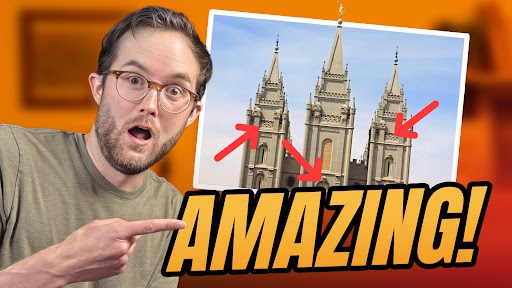
To watch this episode on YouTube, click HERE.
Video transcript:
Do not underestimate the power of symbols. They can dehumanize and destroy, or humanize and heal. They can create community. They can evoke emotion and shape worldviews. Even Jesus Christ taught through symbols that are still relevant today. BUT if you don’t recognize symbols when they’re staring you in the face, they’re pretty worthless. We’re going to look at the top 10 symbols associated with Latter-day Saint temples that you probably didn’t even know were there. Let us begin.
Number 10: Next time you are outside or inside a temple, look for this symbol, the squared circle. You can find it chiseled on walls, inlaid in glass, incorporated into fence designs, embedded in the landscape; it’s all over the place. The circle represents heaven, and the square represents earth, often characterized as having “four corners”. This symbol is appropriate for Latter-day Saint temples because temples are symbolically where heaven and earth meet or overlap. Anciently, in lieu of a physical temple building, prophets would ascend a mountain to encounter God, further reinforcing this idea that temples are where heaven and earth come together, but that’s a goldmine we’re going to explore more when we get to numbers 2 and 3.


Number 9: The compass and the square. If you’ve been through the temple, you already know where these symbols appear. They can and do mean different things in different contexts, but what I think is really cool is their relationship to the Squared Circle, which we just talked about. The builder’s square is used to create right angles, the epitome of which is a square. The architect’s compass is used to create circles. Again, in a roundabout way, we get the circle and the square. More generally, the compass and the square are symbols of creation, which is one of the major themes explored in the temple endowment ordinance. I don’t think there are any temples that currently show the compass and the square on their exterior — there were almost a bunch of them on the Salt Lake City Temple, but they never made it onto the final product.
Number 8: The Big Dipper. A few temples, such as the Salt Lake City and Washington, DC, temples, feature this constellation. It is not just a decoration. The Big Dipper points us to the North Star. In fact, on the Salt Lake City Temple, “The Big Dipper is positioned on the temple’s tower so that one may actually follow the pointer stars of this stationary symbol and locate the North Star out in the heavens.” The North Star doesn’t move and has been used for centuries as a tool for navigation. It has become a spiritual symbol for god, for constancy, and for divine direction and guidance. The temple points to the North Star because the temple is symbolically where lost people can go to find where they belong in God’s cosmic story. And it’s where they can go to learn how to navigate back to our heavenly home, through Jesus Christ.
Number 7: Speaking of stars, you’ll notice that around the Salt Lake Temple, you’ll also see the sun. You’ll see the moon shifting through its various phases as it circles around the building. These stones at the base are earth-stones. It was too hard to chisel the details in granite, but on the original plans, different angles of the earth were also shown around the temple. The original plans also included Saturn-stones. In a way, the temple is a type of planetarium. Hugh Nibley noted that “From earliest times, temples have been built as scale models of the universe.” Again, this is even more symbolism, suggesting that the temple is where you go to figure out where you fit. Nibley wrote that “The temple is a point of reference, a place where you take your bearings on the universe.”
Number 6: As you already know, the 12 oxen underneath our baptismal fonts represent the 12 tribes of Israel. What follows is my own personal speculation, but I find it really meaningful, so take it for what it’s worth. Not only do the oxen represent the twelve tribes, but they also mirror the layout of the ancient Israelite encampment, with three tribes on each side. But it gets even better. Since Joseph’s sons, Ephraim and Manasseh, each got their own tribe, there were actually 13 tribes. The one that is not accounted for yet in that layout is the priesthood tribe, Levi, which performed the ordinances of the Israelite tabernacle. The Levites and the Tabernacle (which represented the presence of God) were positioned in the safest location, the center of the encampment. In modern baptismal fonts, the Aaronic priesthood holder performing the ordinance stands in as the representation of the tribe of Levi, and thus completes the configuration. And I like to think that this is also a reminder that when you enter the center of the font, like the center of the Israelite encampment, you are a sacred temple or tabernacle of God.
Number 5: Another personal observation: As Latter-day Saints, we often compare baptism to the gate that leads people onto the covenant path. In temple,s we vicariously unlock that gate for our ancestors who couldn’t do so for themselves. And I love that in many temples, from above, perhaps unintentionally, the baptismal font is actually shaped like a keyhole. And when you’re in the font, participating in that ordinance, in a way, you’re the key.
Number 4: As you know, when ancient prophets didn’t have a temple available, they would often climb a mountain to commune with God. Temples are symbolic of mountains, and mountains are symbolic of where heaven and earth meet. But it’s also more than that. Ancient Hebrews believed that when God created the earth, he caused the land to emerge out of chaotic cosmic water. Latter-day Saint scholar Donald Parry wrote that “according to one Hebrew tradition, the primordial mound was the first land that emerged from the waters of chaos during the creative period … the primordial mound represented order and definition amidst the unruly chaotic waters.” According to this tradition, not only does the temple represent a mountain, but it also represents the first mountain to emerge during the creation. Not only is the temple where we go to commune with God, but it’s also where we go to find order and safety amidst the chaos of the world. But wait, there’s more.
Number 3: This first primordial mound or mountain is associated with a holy space you might have heard of before, called the Garden of Eden. Now, we don’t generally think of the Garden of Eden as having a mountain within it, but this mountain of the Lord is alluded to in Ezekiel 28, and if there were rivers flowing out of Eden as Genesis indicates, it suggests that yeah, there probably was some kind of hill or mountain for them to flow from.
Point being: Our journey through the temple represents our journey back to the Garden of Eden. In some temples today there is even an intentional elevation change as you progress from room to room — almost as if you are climbing a mountain. The relationship that was damaged through the fall of Adam and Eve is being symbolically restored through the atonement of Jesus Christ as we ascend back to the presence of God in the Garden.
Number 2: We’re taught in the temple that Latter-day Saint temple garments symbolize the coats of skins that God created for Adam and Eve to cover their nakedness after the fall. But this clothing bestowed to Adam and Eve by God wasn’t just a solution to a wardrobe problem. If God made coats of animal skins for Adam and Eve, then a presumably innocent animal or animals had to give up their lives so that Adam and Eve could be covered.
LDS garments represent these animal skins, but what do the animal skins represent? Just like the animals sacrificed in the ancient Israelite tabernacle, these skins represented Jesus Christ. When endowed members need to renew their temple recommend, they are told point-blank in every interview that “When you put on your garment, you put on a sacred symbol of Jesus Christ.” God is symbolically covering Adam and Eve with Christ. Interestingly, in Hebrew, the word “atonement” actually means “to cover.” Yes, our temple garments remind us of the promises we have made with God, but they are also a constant reminder that Jesus Christ has got us covered, too. He is our Savior, and He can fix our broken relationship with God.
Number 1: You’re never going to see this coming, but our number one today is… these guys. The temple workers you meet at the entrance of any given temple around the world. Bear with me. After Adam and Eve were expelled from the Garden, God placed cherubim and a flaming sword at the entrance to protect that sacred space from unworthy visitors. LDS scholar Avram R. Shannon wrote that “Modern temples in The Church of Jesus Christ of Latter-day Saints have similar concepts of gatekeepers who check the credentials to ensure that only the authorized enter.” These workers are not just fulfilling an administrative task. Symbolically, they are sentinels. They are cherubim, or guardians stationed at the gate of a sacred space. If you’ve got your temple recommend and are found worthy, you can pass by these sentinels and begin your journey back to the presence of God. I am eternally grateful that these sentinels are usually very sweet elderly people dressed in white as opposed to the somewhat intense descriptions of cherubim in the Bible. And FYI, this is not the only place in the temple where we see a guardian figure, but I’ll leave that one for you to figure out.
One symbol we did not talk about here, which really deserves its own episode, is the inverted star. And would you look at that, we did dedicate an entire episode to this topic. Totally not controversial at all. Go check it out, and I’ll see you there!